

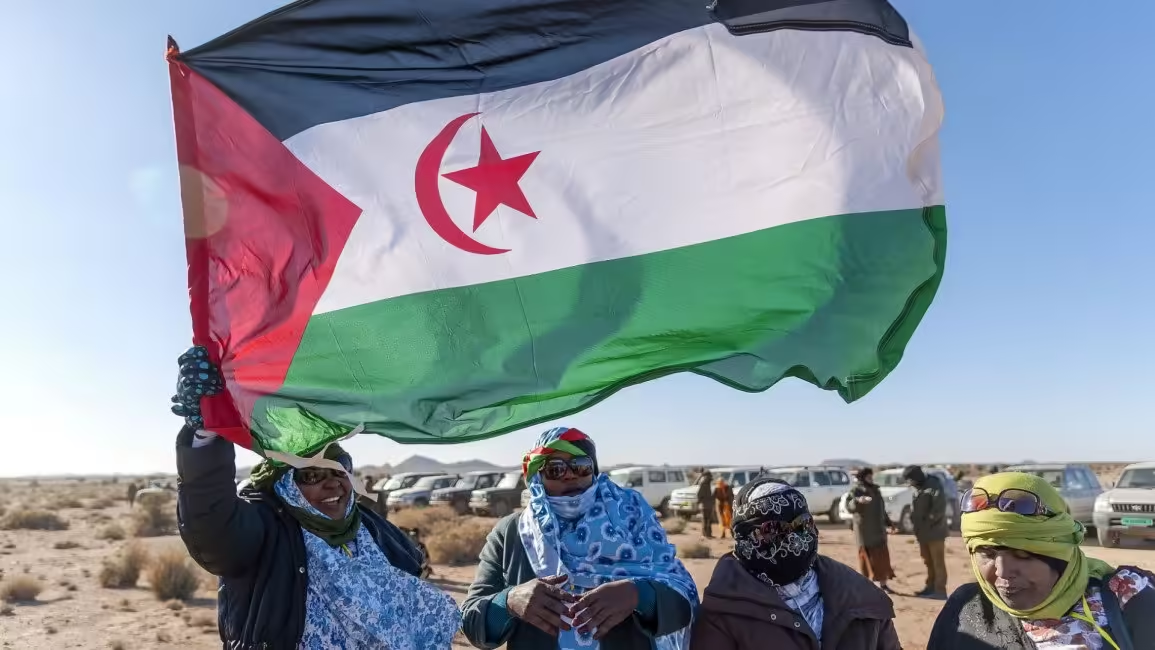
Security Council Resolution on Western Sahara: A Reading Between the Lines
✍️ BY: Dr. Hana Saada
Algiers – November 2025 – What was meant to be a triumphant diplomatic display for Rabat has instead turned into a spectacular reversal — a humiliating setback that stripped the Moroccan narrative of its carefully manufactured legitimacy. At the United Nations Security Council, Washington’s retreat on six major points dealt a crushing blow to the Makhzen’s propaganda, reaffirming the centrality of international law and vindicating Algeria’s unwavering and principled stance on the question of Western Sahara.
Despite the efforts of powerful lobbies and makeshift intermediaries orbiting around the legacy of Donald Trump’s ill-fated maneuvering, truth has resurfaced — as it always does. Rabat may fume and posture, but Algeria continues to advance with quiet determination and diplomatic precision.
Originally crafted to cement the so-called Moroccan “autonomy plan” as the only viable path forward, the draft resolution presented to the Security Council was gutted and reshaped under mounting pressure from Algerian diplomacy. Six decisive amendments transformed what began as a pro-Moroccan text into a reaffirmation of the principles enshrined in international legality — the right to self-determination, the continuity of the UN mission, and the restoration of balance long undermined by Rabat’s disinformation campaign.
The first blow was unmistakable. The mandate of MINURSO (the United Nations Mission for the Referendum in Western Sahara) was extended for a full year — not the three months Morocco had pushed for — signaling the UN’s refusal to let Rabat destabilize or dismantle the framework for a peaceful and lawful resolution. The second came with equal force: all references to curtailing or altering MINURSO’s mission were deleted, effectively closing the door on any attempt to sabotage the process before a long-overdue referendum takes place.
The third point is one of principle — the right of the Sahrawi people to self-determination appears explicitly, twice, in the revised resolution. The phrasing leaves no room for manipulation, returning the text to the language of justice and legality, far removed from Rabat’s diplomatic cosmetics.
But it is in the fourth and fifth points that the shift becomes tectonic. The Polisario Front is once again recognized as a legitimate and indispensable party to the conflict, restoring its rightful position after years of Moroccan attempts to marginalize it. At the same time, the Moroccan autonomy plan — once paraded as the “only realistic solution” — is demoted to the rank of one mere option among others, stripped of its privileged status and rhetorical varnish.
Rabat’s propaganda machine, tirelessly spinning tales of “irreversible progress,” has been struck mute. The illusion of diplomatic dominance has shattered under the weight of reality and the resilience of international law.
The sixth and final turning point reopens the door for new Sahrawi proposals, beyond the suffocating framework imposed by Morocco and its backers. This marks not only a procedural shift but a historic recalibration — a recognition in Washington itself that the Western Sahara question remains, at its core, a decolonization issue, not a geopolitical bargaining chip.
In the end, despite the lobbying power and transactional diplomacy once inherited from the Trump era, legitimacy has prevailed. Rabat is left scrambling for a narrative as Algeria’s measured, principled diplomacy — steadfast, meticulous, and grounded in legality — reclaims the ground that arrogance had eroded.
The verdict is unmistakable: in the court of international legitimacy, Morocco retreats in silence while Algeria advances with conviction — restoring the process to its rightful course and reaffirming the timeless truth that justice, though delayed, can never be denied.
Sneak peek into Western Sahara cause
Western Sahara, noteworthy, is a Non-Self-Governing territory of the UN that lies in the Sahel region bordered by Algeria, the Kingdom of Morocco, and Mauritania. This territory is home to the Sahrawis, a collective name for the indigenous peoples living in and around the region. They speak the Hassaniya dialect of Arabic. Similarly, many others also speak Spanish as a second language due to the region’s colonial past.
Western Sahara has been on the decolonization agenda of the UN and AU for more than fifty years. In 1963, Western Sahara was included on the list of non-self-governing territories under Article 73 of the UN Charter and UN General Assembly Resolution 1514 (XV) of 1960 on the Granting of Independence to Colonial Countries and Peoples.
On November 6, 1975, Morocco launched the so-called ‘Green March,” a march of 350,000 Moroccans, a number four times the size of the Sahrawi population back then, into the territory of Western Sahara.
According to Adala UK, on that day, Morocco organized what it called a “Green March” to officially invade the north of Western Sahara, moving 350,000 Moroccan settlers to the territory. This occupation coincided with the termination of Spain’s status as an administrative power, creating a vacuum that forced the UN to assume its responsibility there.
Subsequently, the UN Security Council deplored the holding of the march, calling upon Morocco to immediately withdraw all the demonstrators from the territory of Western Sahara; however, its effort was in vain.
The Polisario Front liberation movement continued its struggle to end all foreign occupation of its country and, in 1976, formed a government-in-exile and declared the Saharawi Arab Democratic Republic. In November 1984, the Polisario Front’s SADR was recognized by the then Organization of African Unity (OAU), now the African Union (AU), which led to the withdrawal of Morocco from the OAU in protest. In May 1991, the Polisario Front and Morocco ended many years of fighting following an UN-sponsored peace settlement, culminating in the establishment of the UN Mission for the Referendum in Western Sahara (MINURSO), which is assuming its responsibility till today.
Despite a 1991 cease-fire that put an end to armed combat, Western Sahara remains a disputed territory. Nowadays, Morocco controls parts of the territory. However, the United Nations refers to Western Sahara as a non-self-governing territory. After almost 30 years of compliance with a 1991 ceasefire, Morocco and the Polisario Front have resumed war in Western Sahara, as Morocco torpedoed the 1991 ceasefire through its act of aggression on the Saharawi Liberated Territories on November 13, 2020.
The Moroccan new act of aggression has not only ended the ceasefire and related military agreements but has also undermined the UN peace process in Western Sahara and plunged the region into another spiral of extreme tension and instability.
Both the UN Secretary-General and the Security Council have confirmed the breakdown of the 1991 ceasefire on November 13, 2020. In his report (S/2021/843; para 2) dated October 1, 2021, the UN Secretary-General acknowledged, among other things, “the resumption of hostilities” between the occupying state of Morocco and the Frente Polisario. For its part, in its resolution 2602 (2021), adopted on October 29, 2021, the Security Council noted “with deep concern the breakdown of the ceasefire” (PP 14).
The acknowledgment by both the UN Secretary-General and the Security Council of the breakdown of the 1991 ceasefire and the realities on the ground render any attempt to deny or underplay the seriousness of the current situation in MINURSO’s area of operation unacceptable and even misleading at a time when the occupying state of Morocco continues its aggression on the Sahrawi Liberated Territories and its deliberate targeting and killing of civilians and destroying their properties.
📡🌍 | About Dzair Tube Media Group | 🌍📡
━━━━━━━━━━━━━━━━━━━━━━━━━━━━━━━
📰 Dzair Tube is a trailblazer in Algerian digital journalism, delivering high-quality content in Arabic, French, and English. With more than 📈 500,000 daily clicks, it ranks among the most influential media platforms in the country.
🏆 Awarded the President of the Republic’s Prize for Professional Journalist in the Electronic Press category (🗓 October 22, 2022), Dzair Tube is widely recognized for its editorial excellence and integrity.
📱 Massive Digital Reach:
🔴 350,000+ YouTube subscribers
🔵 6 million+ followers across Facebook pages
📸 70,000+ Instagram followers
🎥 Operating from state-of-the-art studios, Dzair Tube broadcasts rich and diverse programming, including:
🗞 News | ⚽ Sports | 🎭 Entertainment | 🕌 Religion | 🎨 Culture
🗣️ Featuring interactive talk shows and exclusive interviews with prominent figures from politics, business, arts, and more, Dzair Tube serves as a key platform for public discourse and civic engagement.
📰 Its print sports daily, “Dzair Sport,” enjoys over 50,000 daily downloads via the official website—further cementing the platform’s multimedia leadership.
🎖️ Honored with the Media Leadership Award by the former Minister of Communication, Mohamed Laâgab, and celebrated at the Hilals of the Television awards, Dzair Tube continues to lead with innovation, influence, and impact.
━━━━━━━━━━━━━━━━━━━━━━━━━━━━━━━
🌐 Stay Connected:
🔗 Website: www.dzair-tube.dz
🔗 English: www.dzair-tube.dz/en
📲 Follow us on Facebook | Instagram | YouTube
━━━━━━━━━━━━━━━━━━━━━━━━━━━━━━━


