


Algeria Stages a Moment of Civilizational Convergence as President Tebboune Receives Pope Leo XIV
By Dr. Hana Saada
Algeria on Monday welcomed Pope Leo XIV at Algiers International Airport, inaugurating a historic official visit that transcends ceremonial formality to reveal deeper geopolitical and civilizational significance.

President Abdelmadjid Tebboune personally received the Sovereign Pontiff upon his arrival, signaling the high strategic value Algiers attaches to this engagement. The reception unfolded with full state honors: the performance of both national anthems, a formal inspection of units from the People’s National Army, and a 21-gun salute marking the gravity of the occasion. Through these carefully calibrated gestures, Algeria projected a dual message of sovereign authority and diplomatic openness—an equilibrium that increasingly defines its international posture.
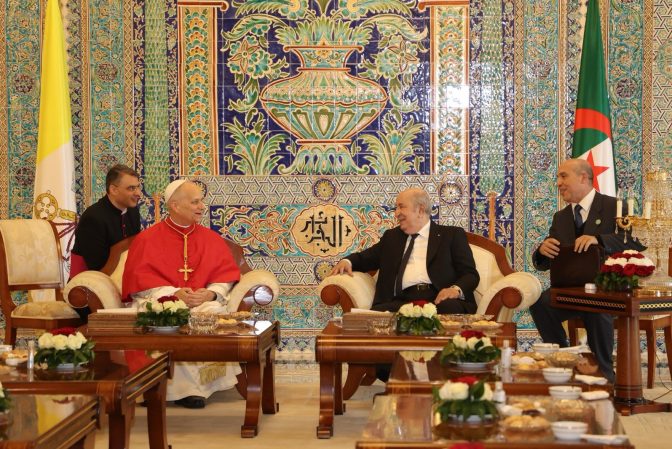
Following the formalities, Pope Leo XIV greeted senior state officials present at the reception, while President Tebboune acknowledged the accompanying papal delegation. The two leaders then proceeded to a closed-door bilateral meeting in the airport’s honorary lounge, underscoring that beyond symbolism, substantive dialogue constitutes a central pillar of the visit.
The itinerary quickly moved from protocol to symbolism of a deeper order. At the Martyrs’ Memorial overlooking the capital, Pope Leo XIV paid solemn tribute to the martyrs of Algeria’s War of National Liberation. By laying a wreath and observing a minute of silence in memory of those who fell on November 1, 1954, the Pontiff engaged directly with Algeria’s foundational history—one rooted in sacrifice, sovereignty, and historical resilience.
This visit, undertaken at the invitation of President Tebboune, unfolds over two days and reflects a carefully structured blend of diplomatic engagement and civilizational dialogue. Its geographic and symbolic trajectory extends beyond Algiers to Annaba, where the legacy of Saint Augustine anchors the journey in a deeper intellectual and historical continuum. The Pope’s decision to begin his African tour in Algeria is neither incidental nor merely logistical; it constitutes an implicit recognition of the country’s unique position at the intersection of religious memory, geopolitical stability, and intellectual heritage.
The program also includes visits to the Great Mosque of Algiers and the Basilica of Our Lady of Africa, as well as meetings with Christian communities and commemorations of Catholic clergy killed during Algeria’s “Black Decade.” Each stage of the visit has been carefully curated to construct a narrative that bridges Islam and Christianity, national memory and global dialogue, past and present.
Statements from religious authorities have reinforced this interpretation. The Archbishop of Algiers emphasized that the visit conveys a message of peace and fraternity between religions, presenting Algeria as a space of encounter rather than division. The symbolic convergence between the Pope’s first words upon his election—“peace be with you”—and the widely shared greeting of peace across religious traditions encapsulates, in its simplicity, a shared ethical horizon grounded in coexistence.
Yet the significance of this visit extends far beyond its interfaith dimension. Algeria is not merely hosting; it is positioning itself as a strategic mediator within an increasingly fragmented global order. In a world marked by identity tensions, geopolitical rivalries, and the erosion of multilateral trust, the Tebboune–Leo XIV meeting reflects a subtle but consequential recalibration of diplomatic language.
It affirms Algeria’s capacity to act as a credible interlocutor in complex civilizational dialogues without compromising its foundational principles. The country’s constitutional framework—anchored in Islamic identity while guaranteeing freedom of conscience and worship—provides the institutional basis for this delicate balance between rooted identity and regulated openness.
For the Vatican, the visit signals a broader strategic reorientation toward Africa as a central arena of demographic and spiritual transformation. For Algeria, it consolidates its emerging role as a pivotal hub of dialogue—linking North and South, Africa and Europe, and fostering engagement between Islamic and Christian worlds.
Crucially, this moment amplifies Algeria’s soft power not through spectacle, but through depth. It is a form of influence grounded in historical continuity, intellectual legacy, and the capacity to produce meaning in an era often defined by fragmentation. Algeria’s layered identity—Arab, Amazigh, Islamic, and Mediterranean—enables it to engage with multiple civilizational narratives without internal contradiction.
As the visit progresses toward Annaba and the intellectual legacy of Saint Augustine, its deeper implications become increasingly apparent. This is not merely a diplomatic visit; it is a repositioning of Algeria within the global imagination, and a reaffirmation of dialogue as a strategic necessity rather than a rhetorical ideal.
The reception at the airport was therefore only the beginning.
What follows may well contribute to redefining the contours of interfaith diplomacy, while firmly establishing Algeria as a central actor in shaping the future of dialogue between civilizations.
— 𝐄𝐍𝐃 —
Dzair Tube Media Group | Record and Standing
Dzair Tube is a leading Algerian digital journalism platform, delivering high-quality content in Arabic, French, and English. With a daily readership exceeding 500,000, it has established itself among the country’s most influential media organizations.
Recognized for editorial excellence and integrity, Dzair Tube was awarded the President of the Republic’s Prize for Professional Journalist in the Electronic Press category on 22 October 2022. The platform operates from state-of-the-art studios, producing diverse programming across news, sports, culture, entertainment, and religion.
Dzair Tube maintains a robust digital presence, with over 600,000 YouTube subscribers, six million followers across Facebook pages, and more than 70,000 Instagram followers. Its sports daily, Dzair Sport, enjoys over 50,000 daily downloads via its official website, cementing its leadership in multimedia journalism.
Further recognized with the Media Leadership Award by former Minister of Communication Mohamed Laâgab and celebrated at the Hilals of Television awards, Dzair Tube continues to set benchmarks in innovation, influence, and public engagement, serving as a key forum for civic discourse, critical analysis, and public affairs.
Official website: www.dzair-tube.dz | English: www.dzair-tube.dz/en


